Provider Data Is Now a Boardroom Issue
Here’s Why AI Changes the Conversation
When most people think about provider data, they think about provider directories. Health plan executives are thinking about something much bigger.
Provider data now influences compliance, reimbursement, member experience, operational efficiency, and increasingly, organizational reputation. As new federal and state regulations reshape expectations around directory accuracy, provider data has evolved from an operational challenge into a strategic business priority.
During a recent conference presentation, H1’s GVP of Commercial, Chris Gardella, explored why this shift is happening and why simply adding AI to existing provider data processes won’t solve the problem.
Provider data has consistently been a problem throughout the course of my tenure at H1—but certainly well before that. With the advent of AI, there are tremendous opportunities to make it better.
The opportunity, however, starts with the data itself. About 30% of provider data changes on an annual basis. If you break this down to a monthly basis, you’re looking at about two percent changes monthly that really lead to inaccurate provider directory audits. The trust is really not there between health plans and health systems – but also not with the patients and the providers themselves. That’s the historical regulatory landscape.
Why Provider Data Has Reached the C-Suite
Health plans have managed provider data challenges for years. What’s different today is the convergence of regulatory pressure, financial impact, and public scrutiny.
Federal legislation such as the No Surprises Act established new expectations for provider directory accuracy. More recently, the REAL Health Providers Act introduced significantly stronger accountability, while states continue to enact their own requirements and enforcement actions.
At the same time, litigation is increasing, regulators are issuing fines, and inaccurate directories are receiving growing attention from attorneys general, the media, providers, and members alike. For executive teams, the implications extend well beyond compliance.
Inaccurate provider data contributes to:
- Higher out-of-network claims costs
- Regulatory penalties
- Litigation risk
- Lower Medicare Advantage Star Ratings
- Member dissatisfaction and churn
- Significant operational overhead across compliance, legal, and customer service teams
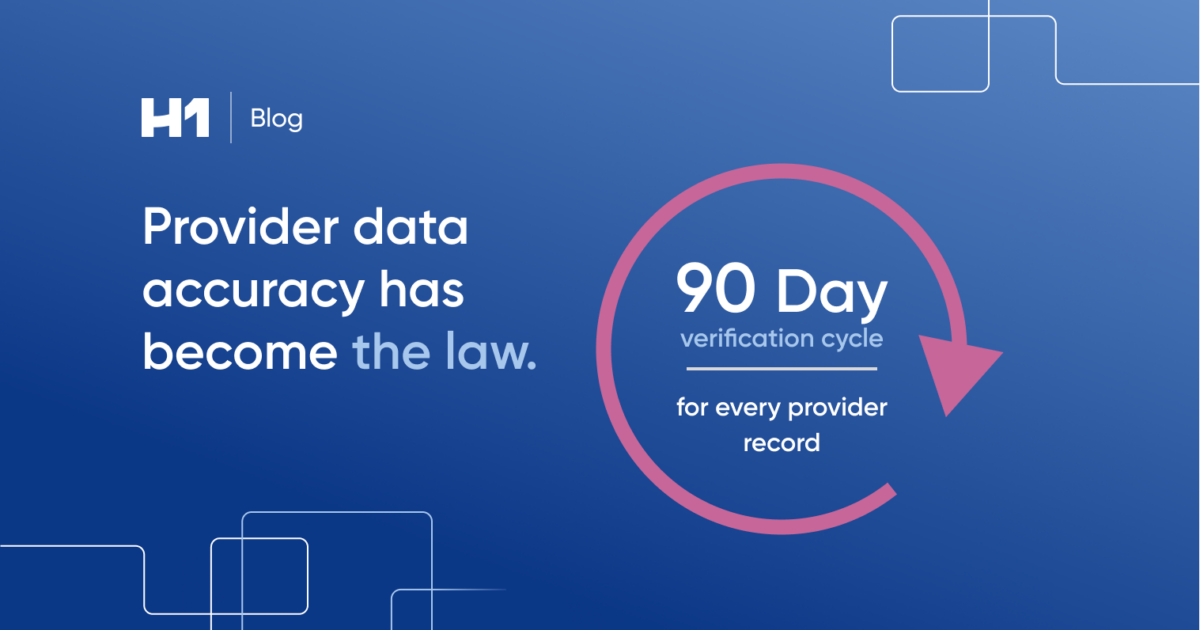
Beginning in 2029, Medicare Advantage plans will also publicly report provider directory accuracy scores, creating an entirely new level of visibility into data quality. “Provider directory accuracy is no longer simply a consumer protection initiative,” Gardella said. “It’s the law.” For many organizations, that changes the conversation from operational improvement to enterprise risk management.
Request a demo to find out how H1 is helping health plans prepare.
AI Is Only as Effective as the Data Behind It
As organizations race to implement AI across healthcare operations, one misconception continues to surface: that AI alone can solve provider data quality. In reality, AI amplifies whatever data it receives. A sophisticated machine learning model trained on incomplete, inconsistent, or outdated provider data will simply produce inaccurate recommendations faster.
As Gardella explained: “Anybody with a data science team can run a great model on bad data. Running a great model on dirty data is only going to lead to bad results.”
Trusted provider data is what allows AI to produce trusted outcomes. That means organizations need to think beyond individual AI models and focus on building a stronger data foundation.
Four Areas Where AI Can Improve Provider Data
While AI cannot replace good data governance, it can dramatically improve how provider data is collected, validated, and maintained when built on the right foundation.
1. Stop Bad Data Before It Spreads
Many organizations clean provider data only after it has already entered downstream systems.
The result is a continuous cycle of contamination: inaccurate records flow into internal systems, are corrected later for directory publication, then return the following month through the same intake process.
Instead, AI can validate and standardize information as it enters the organization, creating a feedback loop that improves quality before inaccurate data spreads. As Gardella put it:
“Take your shoes off before you walk through the house.” Keeping inaccurate information out is far easier than cleaning it later.
2. Continuously Validate Against the Right Signals
Provider information changes constantly. Approximately 30% of provider data changes each year, making periodic or monthly data exchanges increasingly inadequate for maintaining accurate directories.
Organizations need access to a broader ecosystem of continuously refreshed data signals—including authoritative public sources, proprietary datasets, operational workflows, and validated provider interactions—to create a living view of provider information.
Modern API-based data exchange makes this continuous validation possible in ways traditional batch processes cannot.
3. Build Confidence Into Every Decision
Not every provider record carries the same level of certainty. Rather than treating every update equally, AI models can assign confidence scores based on the strength and consistency of available evidence. High-confidence records can be updated automatically, while lower-confidence records receive additional review.
This approach enables organizations to automate far more of the routine work while maintaining trust in the accuracy of the data being published.
4. Let AI Handle Scale. Keep Humans Focused on Judgment.
AI excels at repetitive, high-volume work. Human experts excel at ambiguity. The most effective provider data strategies combine both.
Gardella shared one example where H1 used AI-powered calling agents to complete more than 35,000 provider outreach calls. Approximately 40% of those calls required no human intervention, resulting in roughly 30% time savings and 40% cost savings while allowing staff to focus on the more complex conversations that benefit from human judgment.
Rather than replacing people, AI enables provider operations teams to spend their expertise where it delivers the greatest value.
Regulatory Readiness Starts With Data Readiness
As compliance deadlines approach, health plans should begin asking broader questions than simply whether their directories pass today’s audits.
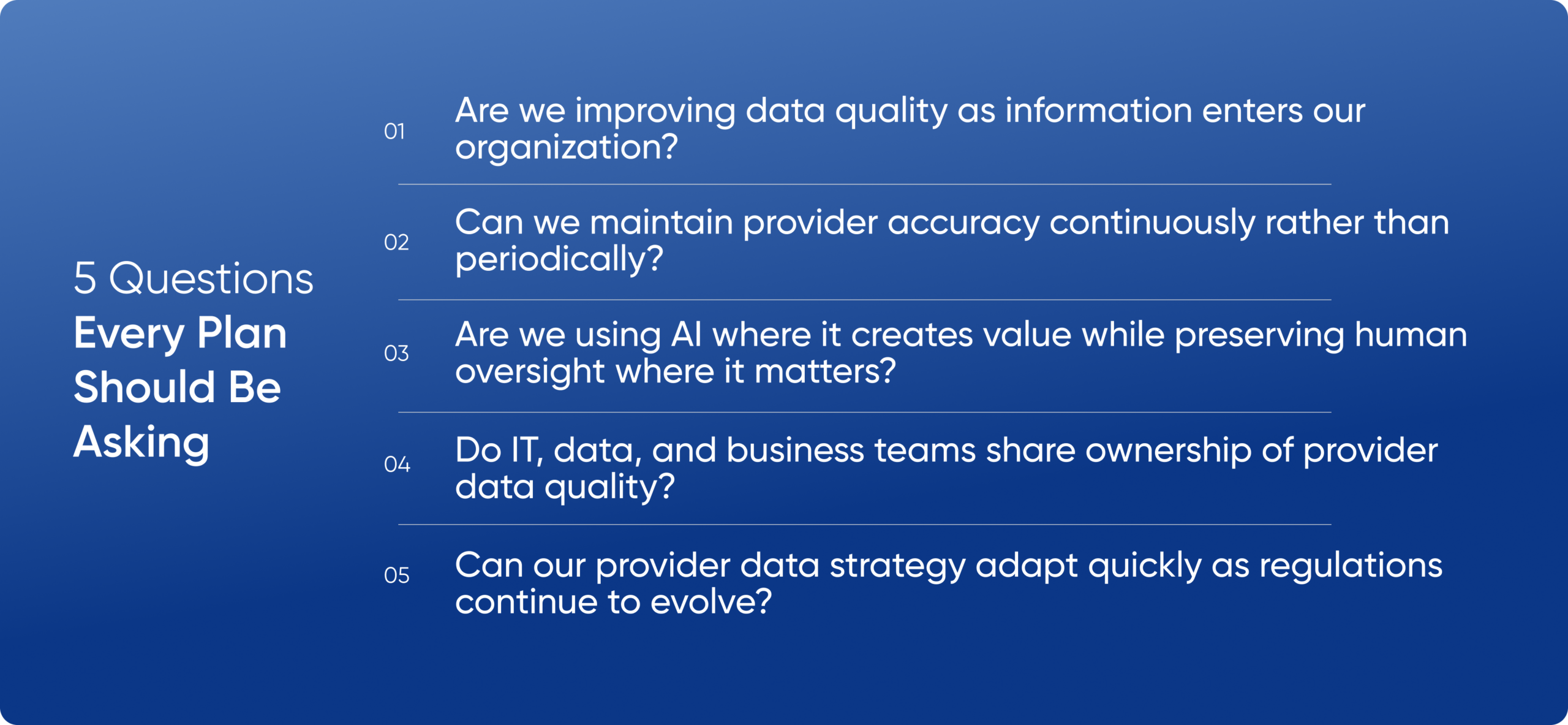
These questions will increasingly determine not only regulatory readiness, but also organizational agility.
The Future of AI Depends on Trusted Data
Healthcare organizations are understandably excited about AI’s potential to automate operations, improve member experiences, and drive better business decisions. But AI is not a shortcut around data quality. It is an accelerator.
Organizations that invest in trusted provider data today will be positioned to unlock AI’s full potential tomorrow—while those relying on fragmented, outdated, or inconsistent data will find that even the most sophisticated AI models struggle to deliver meaningful results.
As provider data becomes increasingly central to compliance, operational performance, and competitive differentiation, one thing is becoming clear: The organizations best prepared for the AI era won’t simply have better AI. They’ll have better data.